Art, Creativity, Photography, Travel, Writing

Archive for the ‘Cambodia’ Category

WP weekly photo challenge: everyday life

I’ve chosen to feature some of the photos I took in Cambodia for this week’s challenge.
These photos were taken in Phnom Pen

201002040187_Wat-Phnom
201002040188_Phnom-Penh-central-market

201002060278_Phnom-Pen-market

201002060281_PP-market

201002060287_sugar-cane
sugar cane vendor

201002060291_turmeric-vendor
turmeric vendor

201002060293_PP-market

201002060307_pineapple-vendor
pineapple vendor

201002060308_fish-kebabs
anyone for barbecued fish?

201002060290_fortune-teller-trimmed
this lady is a fortune teller

these photos were taken in or around Siem Reap

201003030855_Angkor-wat-dancers
for some people, everyday life means hanging around waiting for tourists to take your photo,

201003040920_ice-delivery
or delivering ice,

201003040039_early-evening-in-SR
waiting in your tuk-tuk for the next passenger,

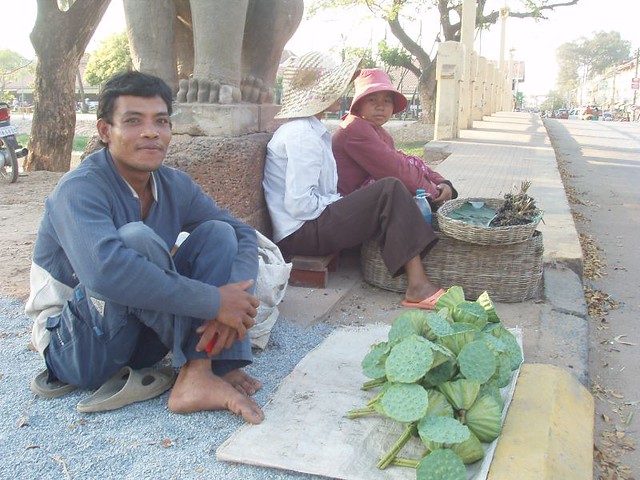
201003040034_boy-lotus-vendor
hoping you’ll sell your lotus fruit,

201003080334
market vendors

201003070328
passing the time of day

201003070324-local-housing
away from the big hotels you might live somewhere like here

201003070325
or here

201003070321_flower-vendors
flower vendors

If you live on the water near Tonle Sap you could be
201003060241_Tonle-Sap-boatyard
boatbuilding

201003060240_Tonle-Sap-boatyard

201003060229_Tonle-Sap-fishermen

201003060187_Tonle-Sap-fisherman
or fishing

201003060227_Tonle-Sap-residents
washing your next meal in the river water …..

201003060223_Tonle-Sap-residents
going fishing

201003060219_Tonle-Sap-floating-dwelling
you might live here

201003060216_Tonle-Sap-floating-village
or here

201003060209_Tonle-Sap-residents
transporting fresh produce

201003060205_Tonle-Sap-residents

201003060203_Tonle-Sap-residents

Travel theme: red

Ailsa challenged us to come us with some photos featuring “red”, however we wished to interpret that. Here are a few red photos, taken in various parts of Asia where red is an extremely popular colour:

201002040191_Chinese-new-year-decorations
decorations for Chinese New Year, photographed in Cambodia

201003030897_child-balloon
a little boy near the entrance to Ankor Wat in Cambodia passes the time of day blowing up a red balloon

201003040027_GB-door-handles
ornamental door handles on the red door to our room in the guest house in Siem Reap in Cambodia

20120123_2525
a red and gold stencilled door

Travel theme: Street Markets

Ailsa has challenged us again to come up with some images from our travels of street markets. I’ve always loved the colour and vibrancy of street markets and the variety of what’s on offer. Some markets may only offer produce but many offer a huge choice of everything a household could possibly need and more besides. Wherever the market is, be it Europe or Asia or beyond, it would be hard to resist the tempting displays. Here are some market images from my travels in Cambodia:

These were taken in Pnomh-Pen

201002060283_PP-market
street markets are wonderfully chaotic places with people jostling to get at the produce

201002060279_Phnom-Pen-market-prepared-dishes
a food stall with food ready to feed the hungry hoardes

201002060281_PP-market
a vendor of floral decorations for the temple

201002060287_sugar-cane
a sugar cane vendor

201002060291_turmeric-vendor
a turmeric vendor

201002060294_banana-flowers-aubergines-okra
banana flowers, mini aubergines, pineapple and okra on sale

201002060298_water-lily-stems
a selection of edible roots and shoots

201002060300_decorated-pumpkins
small pumpkins decorated in honour of the Chinese New Year

201002060301_edible-flowers
more edible goodies

201002060303
rice noodles packed in layers of banana leaves

201002060308_fish-kebabs
grilled cat fish kebabs

201002060309
some things look more tempting than others

201002040189_volutes
a bowl of the sea shells known as volutes, they are such beautiful shells I couldn’t possibly eat them and I was saddened to see them on sale there

these were taken in Siem Reap
201003080334

201003070321_flower-vendors
flower vendors at the edge of the market

201003070320_flower-vendor

201003070318_palm-juice-vendor
get your palm juice here

201003070317_lotus-vendor
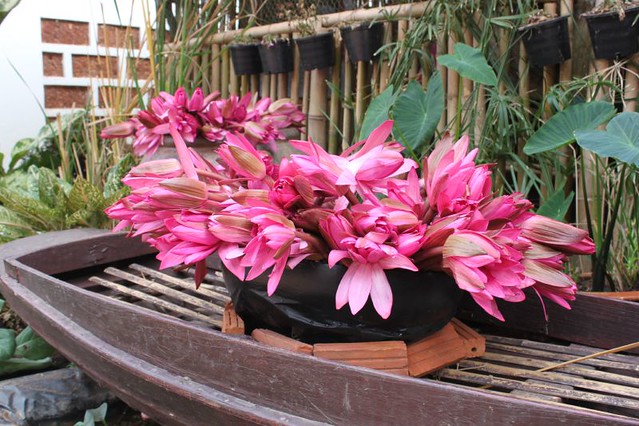
not exactly a market but a street vendor nonetheless of lotus heads

Siem Reap part IV

Saturday 06.03we were rudely awakened at 5.15am by the wedding music again.  After an excellent  breakfast at 6.30 of fresh fruit, fresh orange juice and two boiled eggs with brown bread, we left just after 7am and drove to Chong Khneas to take a boat to Tonle Sap (boat tickets cost 10USD each). There were just the two of us plus our guide in our boat.

The boat goes up the waterway and then out into the lake which is the largest inland body of water in Cambodia (it’s impossible to see from one side to the other). In the wet season all the forest on either side of the waterway is under water for about a month and the rise and fall can be 8 metres in places.

this village will have to be relocated during the wet season

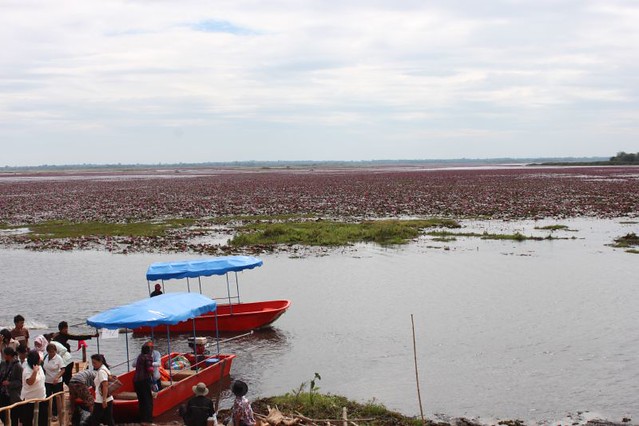
Our first glimpse of the floating village in the distance was an amazing sight.

The Buddhist monastery (in the middle of the picture), built out of concrete and rising several metres above the water surface, is the only permanent building there.

Everyone else lives on boats or rafts floating on oil drums. There was a floating school, floating volleyball court,

a floating catholic church,

floating pig pens,

vegetable gardens, etc.

several kids with pythons round their necks appeared by boat from nowhere wanting a dollar to be photographed but we steadfastly refused. Closer inspection revealed that  most of these people live in dire poverty in conditions which we would consider truly appalling. Many of them are refugees. Everything has to be transported by boat.

We stopped off at a fish and crocodile farm where there was an interesting exhibition of fish, eel and frog traps. Crocodiles were kept in pens under floating docks and the fish farm produced huge cat fish.

I would have liked to spend more time in the floating village as it was quite difficult taking photos in the bright early morning sunshine but the boat went straight back on the return journey, passing a “boatyard” in the making.

We met lots more boats heading out to the village so we were glad we had made the effort to get up and out early.

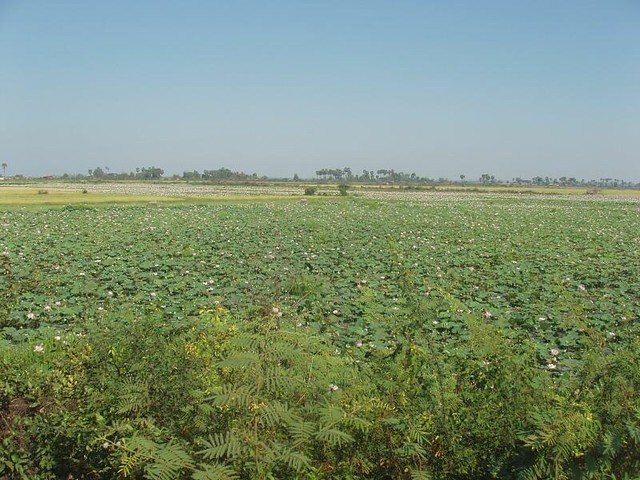
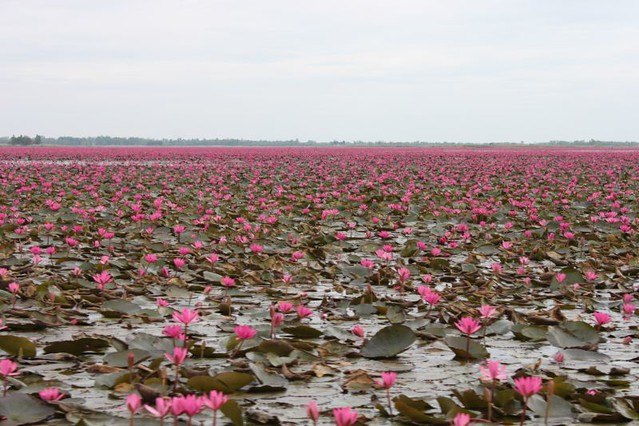
As we headed back towards Siem Reap we passed fields and fields of lotus paddies. I was able to climb down the embankment and walk out on a raised pathway among the flowers.

Our guide purchased a bunch of the green seed heads whose seeds are edible. You need to squeeze the acorn-sized seeds out through the holes and then peel them before you can eat them. They taste of and have a similar consistency to any fresh nut.

Then we went to visit the temples that are known as the Roluos group, starting at Lolei, then Preah Ko and finally Bakong, situated some 13km outside Siem Reap. Lolei was originally an island temple but there is no trace of that nowadays and seems to be overshadowed by the modern monastery which has grown up nearby. Its towers are made of brick and the holes for bonding the stucco on to the building were clearly visible. The figures in the niches and carved lintels were of sandstone which have stood the test of time much better than the brickwork.

Preah Ko, a small brick temple with six towers, had some good examples of remnants of the lime mortar used for decoration. Three figures of the kneeling bull, Shiva’s Nandi, face the steps and give the temple its modern  name “the sacred bull”.

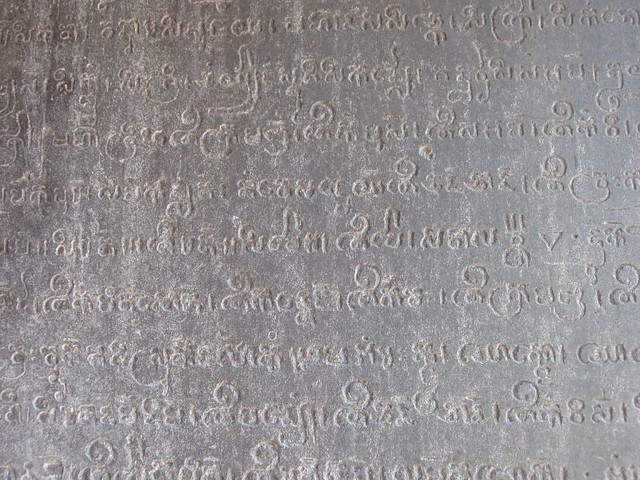
a sanskrit inscription on one of the walls at Preah Ko

Bakong, the last and largest temple in the Roluos group, was another moated pyramid temple constructed of laterite blocks and bricks. I’m sorry to say that by this time I was templed-out and really too hot to take much interest in it so the guide and I just walked around the base of it.

Then we were driven back to Siem Reap to the training centre for craftspeople where we saw deaf mute artists painting on silk,

carvers of wood and stone, gilders and metal workers.

 Once the artisans are trained they are given help to return to their villages and to work independently. There is a shop on the premises (the same shop is also at the airport) and the items on sale were very high quality and priced accordingly.

Various photos taken in Siem Reap: a lotus vendor, a vendor of palm sugar juice, and flowersellers

These beautiful little baskets contained spices and teas. I wish now that I had bought a couple but I was afraid they  would get squashed in our suitcases.

bags made from recycled rice sacks

some of the housing close to our hotel

note the little umbrella protecting the spirit house

the road leading from our hotel up to the main road – very red and dusty in the dry season but can you imagine what it must be like in the wet season?!

the cheapest way to get around was in these tuk-tuks

early morning at the market

Our last night in Siem Reap and we went back to the Amok for dinner.  The starter was a cold beef salad served on a sort of rice puff

and the main course was stir fried pork and vegetables served in a banana leaf basket

We really enjoyed our visit to Siem Reap which was a lively and colourful place. There was plenty of choice of places to eat and a glass of beer only cost 50 cents (US)! I would love to go back towards the end of the rainy season when there is water in the moats and rivers and the temples would have more colour to them.

Siem Reap part III

The following day we got up at 6am so that we could get showered and ready to leave at 7am. We would have been woken at 6.15am even if we hadn’t chosen to make an early start because very loud music started for a wedding nearby. Apparently the earlier and noisier the music the more prosperity there will be for the happy couple.

We started our day with a visit to Ta Prohm which was relatively deserted at that time of morning. Noisy parrots flew overhead but they were difficult to see. Ta Prohm has been left in a “natural” state, i.e. more or less in the condition in which it was first discovered in the nineteenth century, hidden away under twisting vines and invasive tree roots. It was lovely. This was where part of the film Lara Croft was shot. There were mounds of collapsed masonry, and green lichen covered walls everywhere. The trees growing here are the aptly named strangler fig and silk-cotton, both of which extend their roots downwards holding the stones together but ultimately forcing the stonework apart. Originally it was a temple monastery and, according to inscriptions, eighty thousand people lived and worked here to support the monastery. Because of the invasive undergrowth it is hard to get an idea of the scale or complexity and harder still to imagine so many people living and working here.

the famous “Lara Croft” doorway

The only way to prune these immensely tall trees is to erect wooden scaffolding around them!

An army of leaf-sweepers is employed within the archaeological park to sweep up all the fallen leaves as these can harbour insects and other nasties.

After Ta Prohm we drove out into the countryside to visit Banteay Srei, a small red sandstone temple complex set within a moat with some very intricate carvings. It is nicknamed the citadel of women, some people considering that the intricacy of the carvings could only have been made by women!

Then we came back to East Mebon, and Ta Som, Neak Pean and Preah Khan.

East Mebon was a three tiered construction which was originally built in a huge artificial lake. It was hard to imagine what it might have looked like when it was surrounded by water and the only approach was by boat. The towers were constructed of brick and decorated with stucco which would originally have been coloured. The holes visible in the bricks were to provide a better surface for the stucco to bond to. The lintels are made of highly decorated sandstone which was quarried some 40km away. There are elephants at the corners of the temple.

Our next stop was Ta Som, another lovely wooded temple complex whose main entrance lay through a tower with 4 heads on it. It is a miniature, simplified version of the Ta Prohm temple. The towers were originally decorated with stone lotus flowers although most of these have now fallen down.

the lotus flower on the top of the tower is quite visible in this photo

another tree-strangled gateway

Neak Pean was a cruciform arrangement of ponds with a sanctuary tower on a circular island in the middle. The four ponds surrounding the circular central one were empty on our visit as it was the dry season. Two naga serpents, with tails entwined at one side and their heads at the other, surround the island. The horse statue is of Balaha. Four fountains inside four shrines gush water when the pond is full. The finest of these had an elephant and a man’s head as the fountainheads.

Preah Khan is approached via a naga bridge over a moat. Demons line the right side and gods on the left. There is a fine Garuda statue to one side of the entrance. According to inscriptions this temple appears to have been a Buddhist university as well as a considerable city. This was another beautiful, atmospheric place with lots of trees.

this statue apparently represents the perfect woman

her sister was hidden away behind the masonry

frieze in the hall of dancers

more local artwork for sale

We had lunch at one of the tourist restaurants – nothing special although one of the ubiquitous child beggars had a novel line for extracting money from tourists;  he explained that his family had a coin collection and he wanted tourists to give him coins from their country. We didn’t have any coins with us (Cambodia doesn’t use coins only paper currency) but we did give him a Thai note as we were very impressed both by his persuasive line and his good English.

That night we went back to the Amok restaurant for our dinner:

the starter – banana flower salad served on a banana flower petal

the main course – fried pork with ginger served on a banana flower petal

both were quite delicious.

Siem Reap part II

The next day I got up promptly at 4am when the alarm went off, got dressed and went in search of tea and coffee for us both. We met up with our guide and driver and set off at 5am, it was still pitch black. We drove to Angkor Wat to see the dawn and watch the sunrise. The price of 1USD each secured us a chair to sit on and a glass of what was supposed to be coffee but tasted suspiciously like a mix of tea, coffee and chocolate all in one, it was actually pretty disgusting! We watched as the sky went from pitch black with a waning moon and gradually turned pink and then the sun came up. There were lots of other people there too, in fact a whole audience waiting for the sunrise.

just look at all these orbs!

At 5.55am exactly the cicadas started again. It was as if someone flicked a switch and they all started in unison.

the ice man cometh and does saw blocks off with a handsaw! The ice is for keeping drinks cool not for putting in drinks, I hasten to add.

We walked all round the internal covered walkway again with our guide, stopping at intervals as he explained what we were seeing. In the section of 32 hells and 37 heavens was a scene showing an adulterer being forced to shin up a thorn tree and other people being thrown into the sea (we had thought it was a rape scene).  Later we saw one of the same thorn trees in the grounds.

Our guide explained that the basins in the cruciform cloister were not kept filled with water but were used for drainage. Rain falling on the barrel shaped cloistered walkways apparently resembles waterfalls.

At 8am the central stairway to the top was opened and we climbed up to admire the view from there.

It was sad to see that people had felt the need to desecrate the holy area by scratching graffiti on some of the columns and there was a strong smell of urine up there too. However, the view from the top was fantastic and we were able to get a much better idea of the size of the complex – large – and this was only Angkor Wat itself. Angkor Wat itself is only a small part and the archaeological park covers a very large area.

side views

On our way back to the main gate I went to photograph a tree I had noticed earlier  covered in blossoms, now at 8.45am most of the blossoms had already fallen and the ground beneath was carpeted with them.

We were driven to a café for breakfast – just far enough away that we were not disturbed by kids selling things and the food was good too.

Suitably fortified we left there just after 9.30am and drove to the parking area near the south gate of the Angkor Thom complex. Demons guard the right hand side of the bridge and gods the other side, both “teams” holding on a to a naga (a 5, 7 or 9 headed serpent) in a depiction similar to the tug of war in the bas relief of the churning of the ocean of milk.

We got back into the car for the short drive to the Bayon temple itself, in the centre of Angkor Thom (not lazy, we just wanted to stay out of the sun as much as possible :-) .

We visited the Bayon complex which is famous for its 216 faces. At first sight it just looks like a pile of stones …

It was beginning to be hot by now and we didn’t see all the bas reliefs because most of them are not under cover, but only the section featuring the naval battle and some scenes of local life as it was lived 500 years ago. Like the bas reliefs at Angkor Wat these ones (built about the same time) were incredibly intricate and detailed.

When you climb up to the next level there are faces everywhere and wherever you turn you are being looked at by one or more faces wearing an enigmatic smile. Each face is identical (possibly the king’s face) and they were apparently carved in situ, not carved first and then assembled. The stone quarries are some 50km away so bringing the stones to Angkor must have been a mammoth undertaking in its own right.

I usually try and avoid taking photos with people in them but here it’s the only way to give you an idea of the scale

a local artist and some of his water colours for sale

We then left by the north gate

and walked on to the 11th century pyramid temple called Baphuon, again crossing on a long sandstone causeway. This was notable for the large reclining Buddha on the back wall. You might have to look hard to see it.

We walked round the outside of the Phimeanakas (meaning celestial palace), a laterite pyramid-style temple which we didn’t climb. Laterite is an iron-rich clay widely used in SE Asia which is soft and easy to dress, however, after exposure to the elements it becomes very hard and pitted making it unsuitable for dressing.

Nearby were two “swimming pools” which had kids bathing in them. Our guide informed us that the larger one was for the women, which showed that there many more women than men living in the complex when it was originally built. We exited through the west gate and turned left on to the massive walkway leading to the elephant terrace

- so called because of the carvings of elephants, pulling up lotus plants by the roots, using their trunks

and thence to the terrace of the leper king. No one knows exactly why it is called the terrace of the leper king.

Behind this wall of carvings

and protected from the fierce heat of the sun we walked around the base of the terrace where we were able to view the hidden wall. I photographed the nagas and deities of the underworld on this hidden wall.

As you follow the inner wall you can see the increasingly rough chisel marks on the figures, an indication that this wall was never completed.

We passed the large seated Buddha at Tep Prana,

this rather colourful little lizard perched on top of the right foot

and went into Preah Palilay in a woodland setting with trees growing out of the sides of the tower.

By this time we had had enough so decided to call it a day and were driven back to the guesthouse where we both went to sleep for a couple of hours.

Siem Reap part I

Wednesday 03.03 We arrived in Siem Reap at 12.35. Siem Reap airport must have been designed by the people who design Bangkokair’s airports for it was well designed and attractive. There was minimal hassle in getting our visas and we easily found our tuk-tuk driver. The drive into Siem Reap, although less than 10km, was stifling in the midday heat and we were very glad to be in the shade when we arrived at the guest house.

entrance to our B&B

reception area, still with its red lanterns left over from the Chinese new year

One of the lads in reception said he had looked on the internet and found that it was 37 degrees C that day. It certainly felt like it and we were very glad of our welcome iced lime tea with mint and the cold refreshing towel.  With the help of the same lad we organized our programme and guide for the following day and then had a rest for a couple of hours before our tuk-tuk driver picked us up at 4.30 and drove us to the ticket office to get our tickets for Angkor Wat.

The ticket office opened at 5pm and you were entitled to go in to the complex that evening and then start your 3 days next day. We wanted a 3 day pass. When we got to the ticket office itself we were told that we could only have a 3 consecutive day pass and that if we wanted a random 3 day pass we would have to go to a different ticket desk! How frustrating to be told that if you had queued for a long time!

Armed with our passes the tuk-tuk driver then drove us to Angkor Wat itself. At the end of a T-junction you are confronted by the sight of a large man-made body of water with a wooded shoreline on the other side. We followed the road round to the left and then round a corner. As we went down this we caught sight of the causeway crossing the moat to the complex of Angkor Wat itself. The moat surrounds the entire complex. We left our tuk-tuk and then ran the gauntlet of the kids and other hawkers trying to persuade us to buy books, bracelets or postcards. We walked over the causeway, towards the complex – a breathtaking sight.

Angkor Wat is the largest and probably the most breathtaking  of the monuments at Angkor and is believed to be the largest religious structure in the world. The whole archaeological park covers some 120 square km. It was probably built as a funerary temple to the King Suryavarman II (reigned 1112-1152) to honour the Hindu deity Vishnu.  According to our guide book “Angkor Wat replicates the spatial universe in miniature. The central tower is Mt Meru, with its surrounding smaller peaks, bounded in turn by continents (the lower courtyards) and the oceans (the moat).  The seven-headed naga becomes a symbolic rainbow bridge for man to reach the abode of the gods”.

Once you have crossed the first causeway over the moat you pass through the main gateway and then walk along another causeway (no water here).

for a small fee you could have your photo taken with some dancers

We walked all the around the covered walkway area where the best bas reliefs are (eight  hundred metres of them).

dancing girls

inside one of the covered walkways

a statue of Vishnu in his many-armed aspect

Although the section “the churning of the ocean of milk” was closed for restoration a large photographic panel has been erected to show this section. I quote our guide book again:  “this brilliantly executed carving depicts 88 asuras (demons) on the left and 92 devas (deities), with crested helmets, churning up the sea to extract from it the elixir of immortality. The demons hold the head of the serpent and the gods hold its tail. At the centre of the sea, the serpent is coiled around Mt Mandala, which turns and churns up the water in the tug of war between the demons and the gods. Vishnu, incarnated as a huge turtle, lends his shell to serve as the base and pivot of Mt Mandala. Brahma, Shiva, Hanuman (the monkey god) and Lakshmi (the goddess of beauty) all make appearances, while overhead a host of heavaenly female spirits sing and dance in encouragement”.

The majority of the bas reliefs were completed in the 12th century.It’s amazing to think that these incredibly beautiful and intricate carvings were created while Europe was still in the middle ages!

late afternoon sun strikes the cruciform covered walkways in the middle section

and the front of the main section

view from the entrance gate looking back to the main building

From here we watched the sun go down but the final stages of its descent were obscured by trees.

evening sky reflected in the moat

most people have had enough by now and trudge wearily back so it’s a good time of day to visit

my favourite photo of the day

We walked back to the parking area, found our tuk-tuk and drove back into town where we asked to be dropped off in “pub” street. As we drove off all of a sudden the cicadas started their stridulations and the noise was deafening as we approached the outskirts of Siem Reap.

We ensconced ourselves in a bar on the corner of the main crossroads where we had frozen margaritas and nachos. You had to be quick drinking the margaritas because they quickly overflowed as the ice melted.

A young lad with a big smile and only one leg sold us a copy of Ancient Angkor, one of the definitive books on the Angkor complex. We asked him what had happened to him and he told us he’d been in a car accident. We saw many other similar walking wounded, probably landmine victims. Sadly you cannot help them all and we tried hard not to give in to the winning smiles of all the child beggars who accosted us at every temple we visited as it unfortunately tends to encourage them to continue a life of begging.

We got talking to a French woman sitting at the table next to ours and she told us that there were lots of restaurants inside the passages near the old market so we set off to find somewhere to eat.

We settled on the Amok restaurant  (amok is a typical Khmer dish, like a fish soufflé) where we had the set meal of bar (fish) cooked with ginger. It was delicious. After dinner we walked back to the guest house – only about 5 minutes away and very conveniently situated in the Wat Damnak area on the other side of the river – much quieter. We went straight to bed about 11pm.

Royal Palace and National Museum

On our last day we visited the Royal Palace, which bears more than a passing resemblance to Bangkok’s royal palace, and the National Museum. The architecture is very similar to that of Thailand – Cambodia and Thailand were part of the same country in days gone by so that is perhaps not surprising. However, the Cambodian architecture lacks the fineness of detail to be found in Thailand.

In the grounds there were several canonball trees, so called because that’s exactly what their fruit look like (and probably weigh like too). These trees are often to be found in the grounds of palaces and temples.

This canonball tree has a shrine at its base. You can see two of the fruit, on the level with the statue’s ears.

Who said that metal grilles need be boring?

This is the Chan Chaya pavilion which used to be used for performances of classical Cambodian dance; it is sometimes used to commemorate festivals or anniversaries.

You could only visit certain parts of the palace and photos were forbidden in the most interesting areas – the throne room and the silver pagoda, so named for the 5000 solid silver tiles on its floor, each one weighing 1kg. The room also houses a couple of thousand Buddha figures in different sizes and there are thousands of diamonds encrusted on the various figures. The life size gold Buddha figure alone is decorated with 9584 diamonds.

The exterior of the building housing the throne room

throne room tower

the building in the left foreground is the silver pagoda

In the courtyard is a curious iron building given to one of the kings by Napoleon III of France. It is currently being renovated.

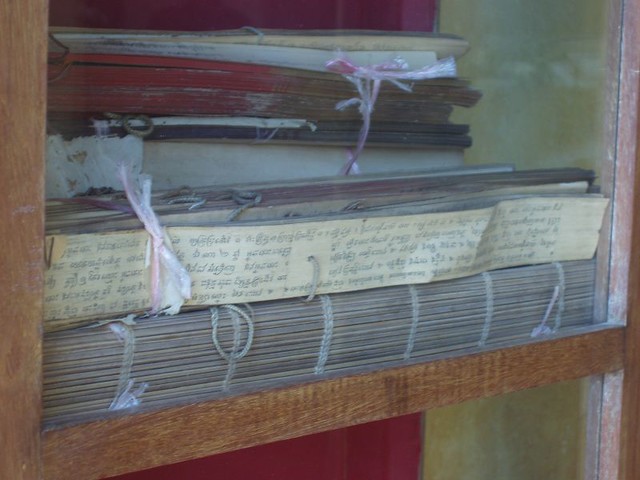
One of the other buildings in the compound is a library housing sacred scripts written on palm leaves.

The topiary has been clipped into giant sized teapots and animal figures.

The epic of the Ramayana (known as the Reamker in Cambodian) is depicted on a mural enclosing the pagoda compound; it was created around 1900.

the red things are parasols minus the covering fabric

these gilt metal parasols are used in processions

This beautifully carved wooden panel was near the exit to the complex. Note the little rabbit in the foreground where the sunlight strikes

We then visited the National Museum, an attractive building in its own right, next door to the palace which houses a fine collection of stonework and statuary.

The exhibits are housed in a building which opens on to an internal courtyard filled with gardens and ponds.

Many of the stone carvings have been brought here for safe keeping from other archaeological sites in Cambodia.

there is also a large collection of stone linga

This is a beautiful wooden barge.

Beautifully coloured and good quality silk scarves on sale here were priced between 12-14USD

food glorious food

We had to get up early this morning because John had telephoned last night to say that we could join in the cookery class today. The three of us took a tuk-tuk to the Frizz where we were joined by some of John’s students from the NataRaj yoga centre (they are former sex traffic workers and are being helped by the Global Transitions organisation to become reintegrated and independent).  Not all the girls could read and some of them had no experience in cooking, they also lack experience in interacting with “normal” people.  John is also teaching them their own history (this was going to include a visit to the killing fields the next day), as well as their own language and Sanskrit. Yoga, until recently, was completely unknown in Cambodia and it is now being used as one aspect of trauma therapy and bodily awareness. John is a visiting teacher to the Nata Raj centre.

John and some of the girls

We started by taking a tuk-tuk to the market where we had a guided tour and were introduced to some of the different fruits, vegetables and herbs.

Early morning traffic chaos

in South East Asia the wearing of pyjamas is not restricted to the bedroom, they can be worn any place and any time and indeed appear to be the preferred item of clothing for women and children

curries bubble away at this food stand – there is no need for a shopper to go hungry at any time of day

a vendor of flowers for temple offerings

a bread stall

baby pumpkins with Chinese new year decorations on them

a fruit and vegetable stall

edible waterlily stems and  morning glory

the small round green things in the basket with okra are apple aubergines , the purple things are banana flowers and the yellow things are ready-skinned pineapples

a sugar cane vendor

turmeric vendor

edible flowers (purple water hyacinth and yellow zucchini), other herbs and vegetables

the pale green fruit in the foreground of this photo are milk fruit – no idea what they taste like

a seafood stall selling bags of mussels, crabs, dried fish and some unidentifiable brown things – sea cucumbers (aka sea slugs) perhaps?

barbecued fish kebabs – the “sticks” are stalks of lemongrass which imparts a very subtle flavour to the fish during cooking

a freshly-peeled pineapple vendor

rice sacks. In Siem Reap we saw these re-cycled into really neat shoulder and handbags

rice noodles – the baskets are lined with banana leaves and each layer is separated with a lotus leaf – this helps to keep the noodles cool

dried fish stall. The fish in the bottom right hand corner are called snakeshead fish (the fish have been slit open and flattened)

crammed into a booth opposite this dried fish stall you could even have your fortune told

Back at the centre, we climbed the spiral staircase to the roof top cookery class area. Fortunately the weather was a bit overcast with a slight breeze. We started off by learning how to grate carrots and taro root and make deep fried spring rolls the proper way.  You don’t use the central core of the carrot in the spring rolls, as it is too hard. This Cambodian carrot grater was far better than anything else I have seen but alas we didn’t manage to find one before we left.

Next item was banana flower salad with chicken. You have to remove the dark reddish purple outer petals from the banana flower until you just have the white ones left. You also need to remove the white finger-like things (future bananas if the flower had been left to mature on the plant)

As you slice the flower put the pieces into water to which you have added the juice of a lime – this stops the banana flower from going brown.  The correct way to slice a lime so that you don’t get seeds in the juice (basically you cut three slices off the outside of the lime leaving a triangular core containing the seeds.  The slices look really nice when cut like this).

the finished salad

Pounding the paste for the Amok – we were exhausted long before it had reached the right consistency so our Cambodian friends gave us a helping hand

The most difficult part of making the fish Amok was the construction of the banana leaf container.

This was followed by mango with sticky rice and caramel sauce made from palm sugar. Peel one half of a mango, make diagonal cuts across the flesh and then pass a knife under the cuts as close to the stone as you can. Turn over and repeat on the other side. This will give you the beautiful slices of mango as seen on the dish.

We all sat down together to eat each dish as we prepared it. It would have been much too much food to have eaten all at one sitting. Some of the girls took most of their fish amoks home with them, they were particularly rich and filling.

The class lasted most of the day and we had a really good time. Some of the girls were more friendly than others but this was due more to their knowledge of English (or lack of it) than anything else and they seemed to be a happy group. I hope that with John’s help and the help they receive from Transitions they will be able to make something of themselves.

RECIPES

Banana blossom salad with chicken

serves 2

1 banana flower

2 tbsp mixed herbs (mint, basil, fishwort, coriander (cilantro)

150g chicken breast cut into pieces

1 chilli pepper, finely sliced

juice of 1 lime

dressing:

1 chilli pepper

1 bird chilli (optional as these are very fiery)

juice of 2 limes

3 cloves garlic

2 shallots

1 tbsp fish sauce

1 tbsp palm sugar

1 tsp salt

1 cup mineral water

Cook the pieces of chicken breast until cooked wll and set aside to cool down.

Remove the leaves of sweet basil, coriander, fishwort and mint from the stems. Large leaves can be cut into smaller pieces.

For this salad you only use the young (inner) parts of the banana flower, so first take off the pink-purple outer layers.

Cut the young flowers into thin slices. To prevent them turning black, immediately rinse the slices in diluted lime juice for 5 minutes, then take out and set aside.

For the dressing, cut chilli pepper, bird chilli and garlic into pieces, put them in a mortar and grind a little (not to a paste!). Put ground peppers and garlic in the mineral watr add shallots, fish sauce, lime juice, salt and palm sugar to taste. Mix well.

Put the banana flowers into a bow, together with the chicken, the mixed herbs, chili and dressing and mix well. Arrange nicely on a plate.

Amok, the kroeung (curry paste)

Amok is a Cambodian curry which is steamed instead of boiled and is solid, but moist. One of the two traditional types of amok is cooked with fish and steamed in banana leaf cups.

Kroeung ingredients:

5 dried chillies (soaked, drained and chopped into a paste) or fresh

3 cloves garlic

2 tbsp galangal cut small

1 tesp lemon grass, thinly sliced

zest of 1/4 kaffir (or ordinary) lime

1 tsp salt

Combine all the ingredients in a food processor and blend to a thick paste. Alternatively (and more traditionally and more time consumingly) this can be done in a mortar and pestle.

Refrigerate any paste not needed for the amok; it can be used to add a little kick to soups and stir fries.

Amok ingredients:

30g young nhor leaves (no real substitute)*

3 tbsp fish sauce

3 tbsp kaffir lime leaves

3 chilli peppers

500g any meaty fish

3/4 cup coconut cream

2 cups coconut milk

1 egg, beaten

Further procedures:

slice the fish thinly and set aside. Remove the nhor leaves from the stem, slice the kaffir limes leaves and chillip peppers thinly. Stir the kroeung into 1 cup of coconut milk. When it has dissolved, add the egg, fish sauce and sliced fish. then add the remaining coconut milk and mix well. Make the banana leaf cups, then put in the nhor leaves first and top with the fish mixture. Carefully place the banana leaf bowl into a steamer and steam for 15-20 minutes, then put the coconut cream on top and the thinly sliced kaffir lime leaves and chillies. Steam further until the mixture is solid, but still moist.

(this is a very rich dish!)

Amok, the banana cup

Making the banana cup:

first clean the leaves with a wet cloth, then dip them into boiling water so they are soft and do not crack when being shaped.

cut circles 25cm in diameter and place two together. This is important as one leaf is not strong enough to hold the mixture.

Make a square in the middle of the circle, this will be the bottom of the cup.

Then, put a thumb on one right angle of the square and pull up 2 sides, tucking the fold, and pinning together with a half a cocktail stick. Move the next right and repeat. Continute until all 4 sides of the cup are held together.

*Nohr is morindia citrifolia sometimes known as “noni”. I have seen this tree growing in Thailand. I nicknamed it the Startrek tree because the fruit look so weird and they squish underfoot (they look really disgusting). Opinion is divided as to what to use for a substitute, some people favour lemongrass or kaffir lime leaves but I reckon Thai basil or Thai holy basil would be just as good

a trip to the countryside

For our second day we took a drive into the countryside to visit the hilltop pagoda at Phnom Chisor, apparently a good introduction to Khmer architecture if you hadn’t yet seen the glory of Angkor Wat, and the Angkorian temple of Ta Prohm at Tonle Bati (I personally think this was a rather generous description on the part of the guidebook’s author!). The drive out into the countryside was fascinating.

We started off by stopping to look at the morning glory “fields” on the outskirts of PP. The morning glory is planted in the water-filled fields and is ready for harvesting about one month later. It’s not the morning glory vine with the bright blue trumpet shaped flowers but is similar and is a basic ingredient in many Thai and Cambodian stir-frys.

We saw bicycles and trailers piled high with the stuff. We also saw gourd vines with yellow flowers trailing over supports.

The houses along the edge of the road are built on stilts – in the wet season the water level rises almost to road level.

We saw several buildings draped in brightly coloured cloth – mostly yellows and pinks and were informed that this was for weddings.  Ducks paddled in the ditches (a bit like Bali) and there were loads of very scrawny-looking cattle grazing in the fields. As this was the dry season everywhere looked very brown and dry. It would have looked very different if this had been the wet season with all the rice fields forming a green patchwork.

After a couple of hours drive (distance approx 30km) along the main road heading to the south of the country (nothing like the main roads to which we are accustomed) we turned onto a track crossing flat, open countryside scattered with a few trees. We had arrived at Phnom Chisor, a 130metre high “mountain”. The guide book indicated that you had to climb 390 steps to get to the top!  Armed with an umbrella to keep the sun off me (it was now 11.30am) and a bottle of water, I set off. DH abandoned me to my own devices after the first 50 steps and descended to keep the car driver company.  I stopped several times on the way up to catch my breath. At a shaded resting point at 250 steps a couple of monks and a friend asked if they could take my photo. No problem, I said and asked if I could take theirs in return – of course. Their friend was acting as photographer for them.

I then climbed on and had to catch my breath again at the top. By now I had been joined by several barefoot children, the oldest of whom was now acting as my self-appointed guide. She explained to me what some of the carvings depicted.

views from the summit

Phnom Chisor is still an active temple and now also has a modern temple at the summit. This is the reclining Buddha in the modern temple.

On the way back down, at the shady resting point, I met a group of French tourists. I told them they still had another 140 steps to go. They replied that it was obvious that I had been to the top as my face was now the same colour as my hair!

The weaving school in the grounds of the monastery at the bottom of Phnom Chisor, it was lunchtime so the place was deserted

We then went to visit the temple of Neang Kmao (which means black lady). There are only two dilapidated towers here, only one of which was open, which had a yoni stone in it (for fertility). Inside the main temple, a modern concrete affair, the ceiling and upper parts of the walls were decorated with murals, the latter illustrating scenes from Buddha’s life. It starts with the picture of his mother dreaming of a white elephant when she is pregnant. The next panel depicts Buddha, 3 days after his birth, able to walk on lotus leaves.

Next we turned off the main highway to drive several kilometers down a dirt track which might be better named the road of the water throwers. Old people who have no family and have therefore become destitute (there is no state aid) eke out a subsistence by begging along the road and by throwing bowlfuls of water on to the track to keep the dust down. We distributed money to each of the beggars on our return trip, feeling a bit like royalty handing out largesse. Each time we handed over money we were wished good luck and long life.

Our destination here was the Phnom Takmao wildlife sanctuary and zoo. As soon as we got out of the car a group of youths attached itself to us, flogging coconuts (expensive at 1USD per piece!) as animal food. I would have like to be able to wander around unaccompanied as the youths were chattering away like monkeys, frightening off all the birds. I had seen a blue bee eater sitting on a post as we entered the site and later caught sight of a hoopoe.

We saw herons, storks,

yellow throated martens,

flying squirrels,

white squirrels, lots of gibbons, sun bears and Asian black bears, 2 tigers and some elephants.

After this we drove back along the dirt track to the temple at Ta Prohm, a very popular temple and one which looks lovely because there were masses of flowering shrubs but where we again attracted the attention of the local beggars.

carving of a celestial nymph

and another heavenly body

I’m sorry to say that I was so discouraged by all the beggars that I cut short our visit there. Our last stop was the lake of Tonle Bati where we had a much needed drink before returning to the hotel. This is where many of the locals go at the weekends, taking their own picnics and hanging out in the cafes floating on the water.

Housing belonging to the well-to-do

and not so-well-to-do

On the way back to Phnom Penh we saw lots of stalls selling barbecued frogs – we weren’t tempted.

Follow

Get every new post delivered to your Inbox.

Join 267 other followers